The Hidden Hand Farms: How India Became the World's Motion Capture Lab for AI Robots

Inside the factories where human hands are being recorded, frame by frame, to teach machines how to replace them.
Why should you care about factory workers wearing cameras?
Honestly, we want robots to do dangerous, repetitive, and physically exhausting work. Nobody should spend 12 hours a day in a garment factory for Rs 20,000 a month. If robots can fold towels, assemble electronics, or clean hospital rooms, that's progress.
But the problem is in the how.
The workers training these robots often don't know they're doing it. According to Times Now (May 20, 2026), workers at Pearl Global Industries in Gurugram were told to wear camera-linked devices during their shifts — no explanations, no consent forms. When asked if they knew the footage was for training AI, they said no.
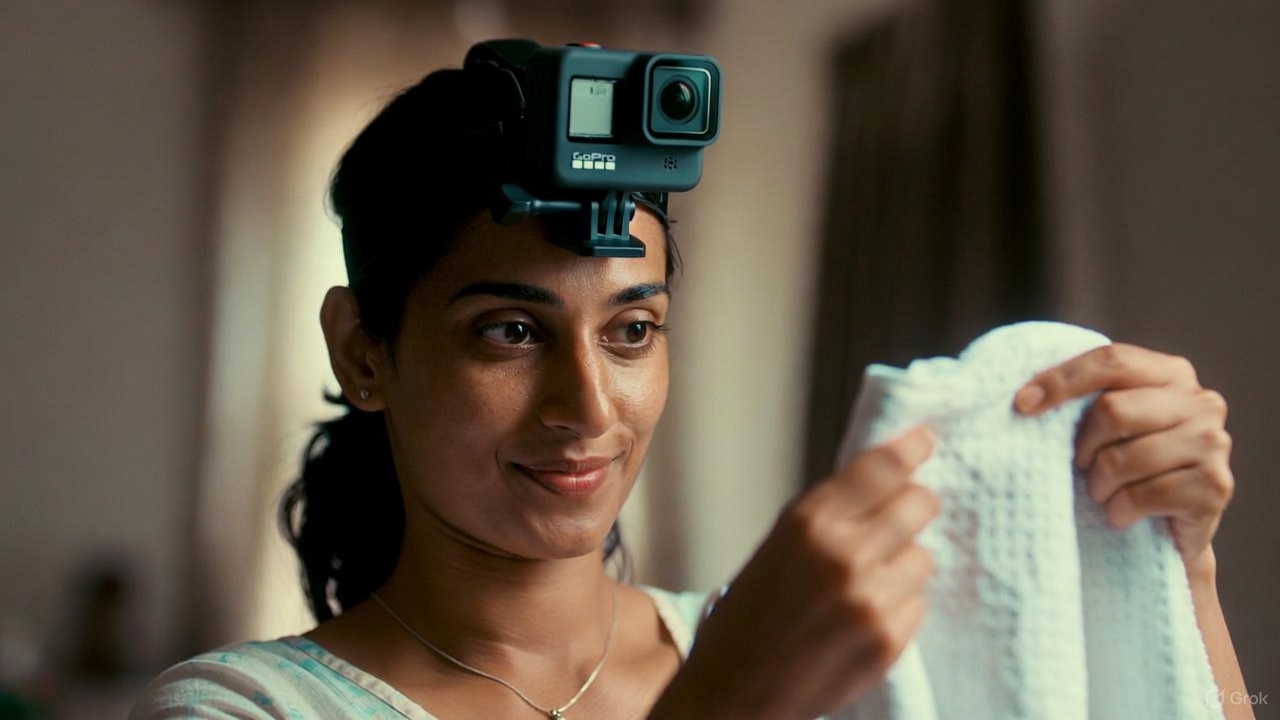
The cameras captured everything: hand movements, facial expressions of coworkers, conversations, even bathroom breaks. "We had to take it out before going to the toilet," one worker said. "Moreover, we couldn't speak to our spouse while wearing it. It could listen to our conversation."
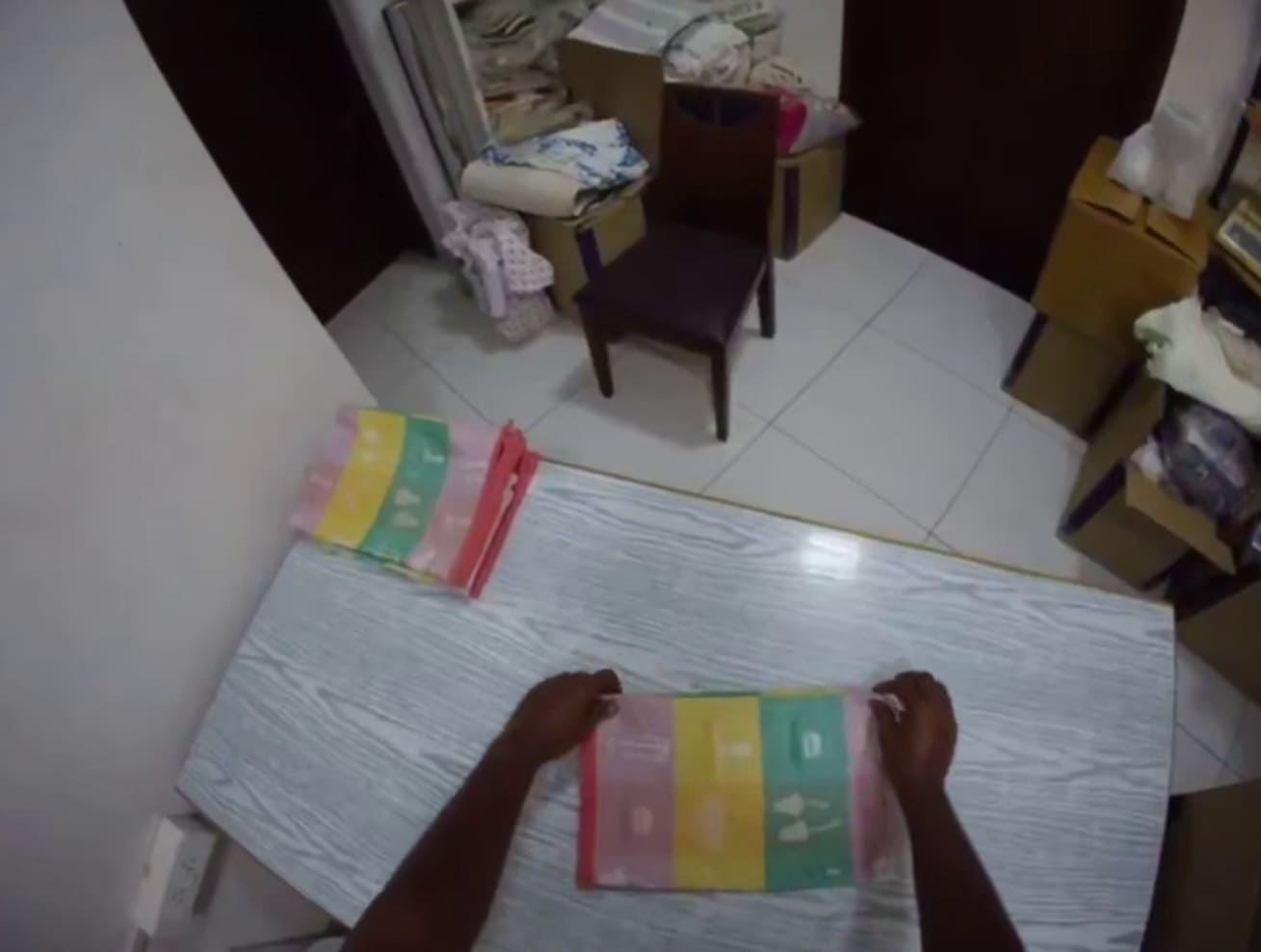 A worker in a data capture lab, GoPro strapped to their forehead, recording motion data for AI training. Source: Quasa.io
The people creating the most valuable training data for trillion-dollar AI companies are paid less in a day than those companies spend on a single GPU hour. They don't share in the upside. And once the robots are trained, their jobs disappear.
We are not anti-technology (we are software developers!). It's about whether the humans training the machines get a say in how, when, and at what cost. Because if this model becomes standard, and right now it is, the future of work looks very different depending on which side of the camera you're on.
The Camera on the Forehead
In April 2026, a video went viral. Factory workers in Gurugram, India, were sewing garments while wearing white headbands fitted with small cameras. The footage sparked a simple, unsettling question: are these workers training the robots that will eventually take their jobs?
The answer, it turns out, is yes.
The viral video that sparked global debate about Indian factory workers wearing head-mounted cameras, unknowingly training the robots that could replace them.
Across factory floors, warehouses, kitchens, and retail spaces in India, workers are wearing head-mounted cameras that record hundreds of thousands of hours of "egocentric" data — first-person point-of-view footage capturing every hand movement, every object interaction, every instinctive adjustment. This data is being packaged, annotated, and sold to robotics labs in Silicon Valley to train the next generation of humanoid robots.
India has now become the global hub for this emerging industry. And the scale is staggering.
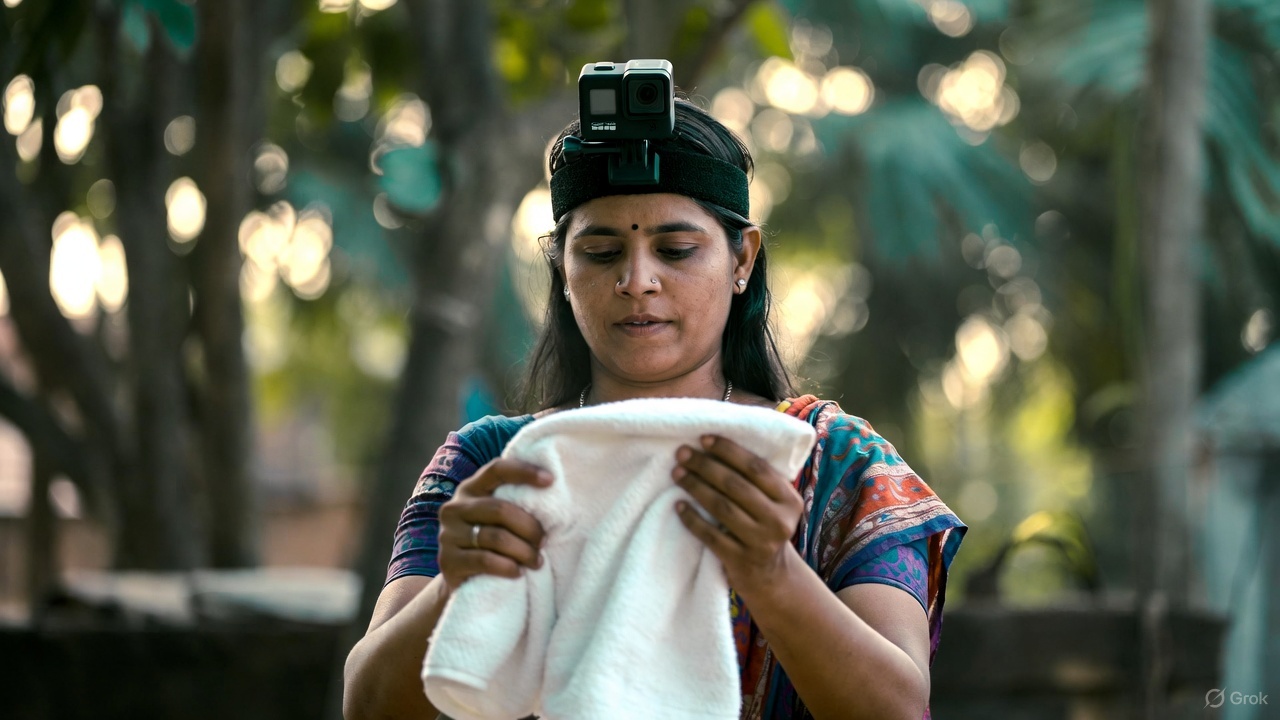 Inside India's "hand farms" where human motion becomes robot training data. Source: Quasa.io
What Is Egocentric Data, and Why Does Robotics Need It?
Egocentric data refers to video and sensor recordings captured from the perspective of the person performing a task typically via cameras mounted on the head, chest, or wrist. Unlike static third-person footage, this first-person viewpoint replicates exactly what a robot would "see" when navigating the real world.
For robotics companies building humanoid machines, from Tesla's Optimus to Figure AI's prototypes, this data is critical. It captures fine-grained details that traditional footage misses: how fingers grip a slippery fabric, how wrists adjust when a screw doesn't align, how experienced workers recover from mistakes without thinking.
According to a report by Stellaris Venture Partners, leading robotics labs need 100 million to 1 billion hours of egocentric data in the next two to three years. At an estimated cost of $15–50 per hour of collected footage, that implies a cumulative market spend of $1.5 billion to $50 billion.
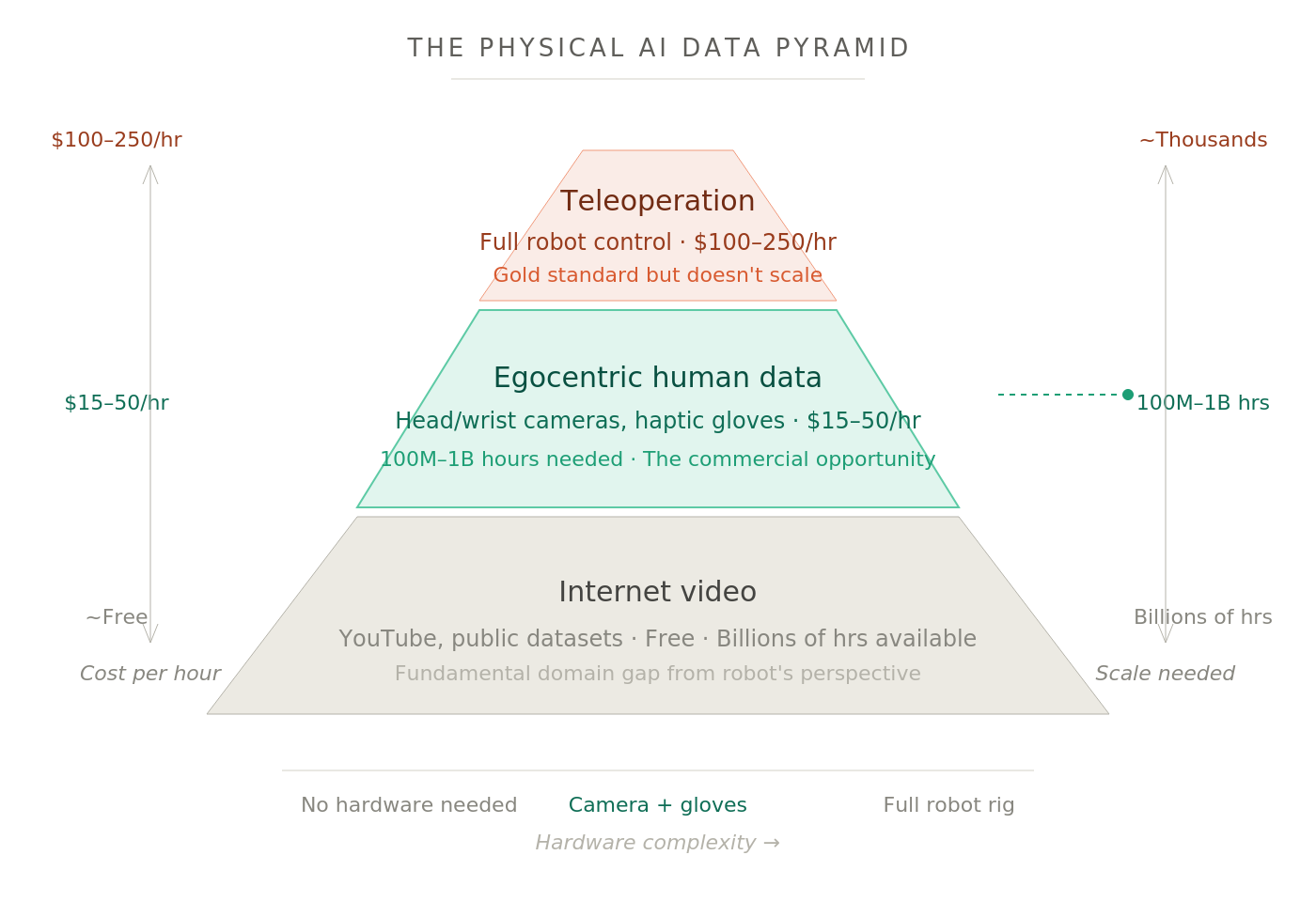 The data pyramid for Physical AI: internet text trained LLMs, but robots need first-person video that doesn't yet exist at scale. Source: Stellaris Venture Partners
The central insight driving this demand is that there is no "internet for robots." While large language models were trained on trillions of tokens of text already sitting on the web, physical AI has no such luxury. The models that will power humanoids need to learn from first-person video of hands interacting with real objects — with depth, force feedback, and the texture of actual materials.
As one researcher at a leading robotics lab told Stellaris: the field currently sits at roughly 0.1% to 1% of the data volume that LLMs required to reach frontier capability. The gap is 100x to 1,000x. And that gap is the central bottleneck in Physical AI today.
The Indian Ecosystem: Startups, Factories, and a Cost Advantage
India's emergence as the epicenter of egocentric data collection is no accident. The country combines three factors that make it uniquely positioned: a massive manufacturing workforce (over 300 million people employed across MSMEs), relatively low labor costs, and an established IT services infrastructure that can handle data annotation at scale.
The Key Players
Humyn AI operates a verified network of data collectors across 18 countries, with significant operations in India. Co-founder Ishank Gupta explains that training a robot for even a single context, say, picking up a glass and placing it on a shelf, requires between 100,000 to 1 million hours of data. For general-purpose robotics, the consensus estimate runs into the billions of hours. "These billions of hours of data cannot be scraped and have to be created," Gupta told The Economic Times, "because there is no repository in the world which has such data."
Objectways, a data collection firm with offices in Karur and Coimbatore, Tamil Nadu, has pivoted from LLM data to physical AI data collection. President Ravi Shankar told The Economic Times that his company is currently processing 1,000 hours of data per day, against demand for 200,000 to 300,000 hours. Objectways started with GoPro cameras and Meta glasses, then designed its own mobile app when consumer hardware proved insufficient for long recording sessions.
FPV Labs has collected over 10,000 hours of real-world data in the past eight months, but co-founder Abhishek Anand says the company isn't selling raw data. Instead, it's investing in infrastructure to "capture, validate and evaluate high-quality data that transfers human state and action representations to robots."
Neo Cambrian is deploying proprietary hardware across manufacturing units in India to collect what co-founder Abhinav Kukreja calls "accurate and detailed data closer to the real world environment."
ManuData takes a different approach, tapping into India's 63.4 million registered MSMEs — of which 11.7 million are in manufacturing. The company deploys multi-camera hardware depth rigs (Intel RealSense + ZED 2i) across factory stations, capturing not just video but 3D body pose, hand kinematics, and 6DoF object tracking. Their pitch: "The tasks that are still manual here are precisely the tasks robots struggle with most."
Build AI, led by 18-year-old Columbia dropout Eddy Xu, has moved fastest. After acquiring Egolab.AI — a startup founded in January 2026 by two teenagers in Maharashtra — Build AI released Egocentric-100K, a dataset of 100,405 hours of first-person factory footage from 14,228 workers, totaling 10.8 billion frames and 24.79 TB of data. The company has raised $15 million from investors including Balaji Srinivasan, Guillermo Rauch (Vercel), and Thomas Wolf (Hugging Face).
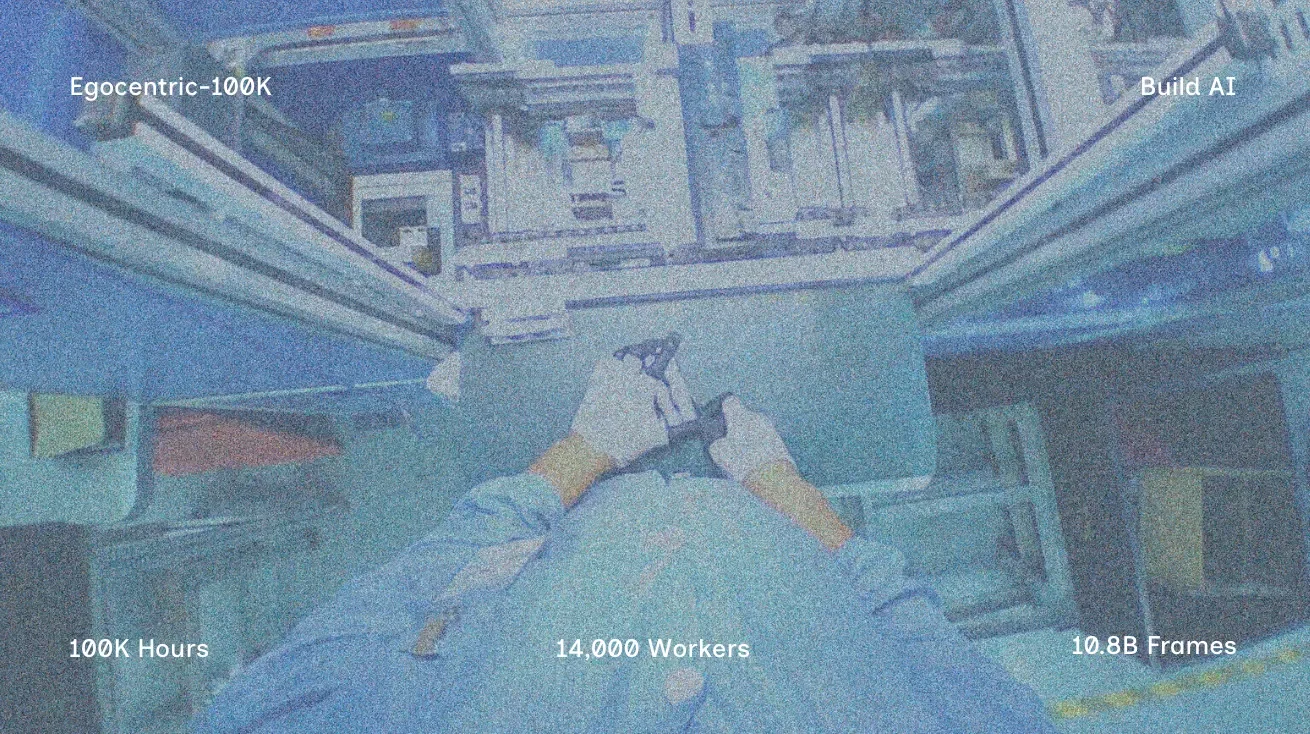 Build AI's Egocentric-100K: every pixel represents one of the 10.8 billion frames captured by 14,228 factory workers. Source: Humanoids Daily
Other players include Sentientx (teleoperation and motion capture with a claimed 5x cost advantage), SHIRO BPO (Mysore-based data annotation for humanoid robotics), and XP Robotics (physical AI data platform).
The Human Cost: What Workers Are Paid and What They Give Up
For the workers powering this pipeline, the rewards are modest. Data collectors in India earn roughly Rs 250–400 per hour ~ approximately $3 to $5 per hour. Full-time annotators and motion capture workers report monthly salaries in the range of Rs 19,000–21,000 ($230–250), with part-timers earning as little as Rs 10,000–20,000.
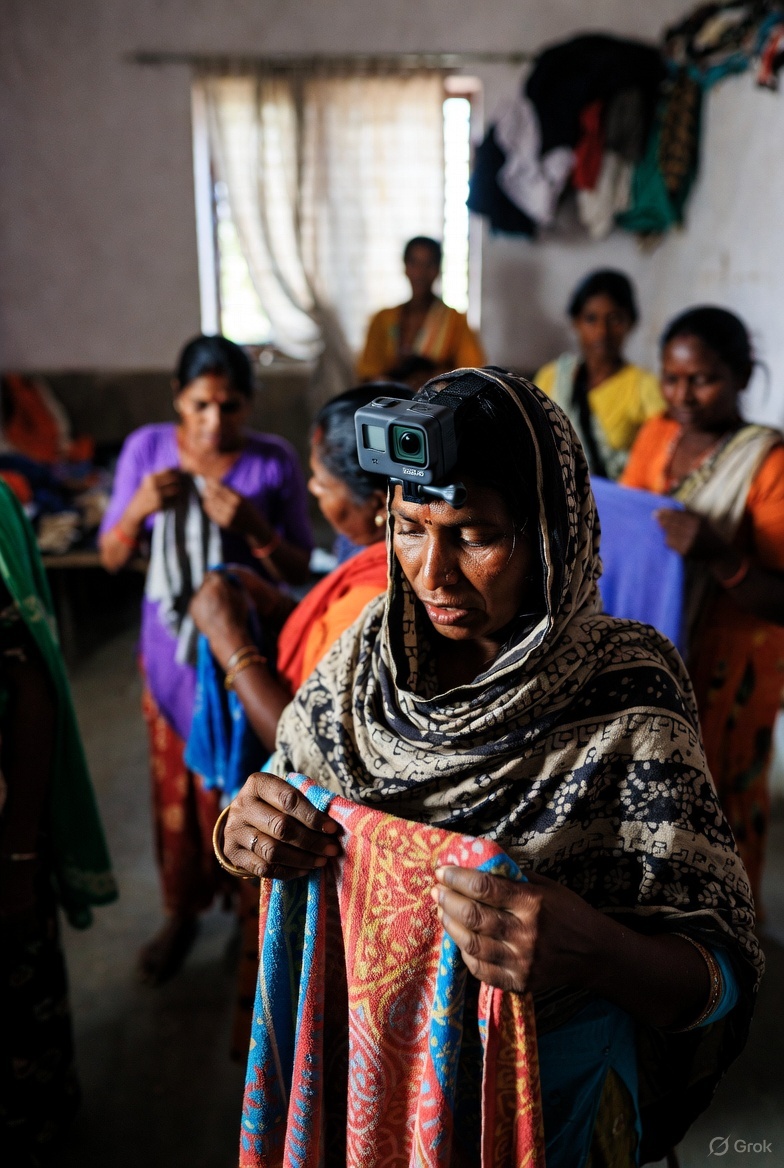
The work itself is grueling. Workers report eye strain from head-mounted cameras, wrist fatigue from repetitive manipulation tasks, and the mental toll of performing scripted actions — fold a towel three times, place it in the left corner, restart if you exceed 60 seconds — for hours on end.
 Inside a motion capture lab: workers repeat the same actions hundreds of times while cameras record every micro-movement. Source: Quasa.io
The irony is sharp: human workers are being paid poverty wages to record the precise movements that will train machines to perform those same tasks without human workers at all.
 The economic gap: workers earn $3–5/hour to generate data that will power a multi-billion dollar robotics industry. Source: Quasa.io
The Technical Breakthrough: Why This Data Matters Now
The surge in egocentric data collection isn't just about having more video. It's tied to a specific technical shift in how robots are trained.
The current frontier in robotics is a new type of AI model that combines three things: visual perception, language understanding, and physical movement. Think of it as an AI that can see, understand instructions, and actually do things in the real world.
Here's the breakthrough: when these models are trained on enough footage of human hands performing tasks, they spontaneously learn to copy those movements onto robot hands. No engineer sits down and programs each finger joint. The AI figures it out by watching.
A leading robotics lab called Physical Intelligence demonstrated this in early 2026. They trained their model on hours of human demonstration data — people folding towels, picking up objects, assembling parts. The model learned to translate those human hand movements to a robot gripper with completely different mechanics. Without explicit programming for each joint.
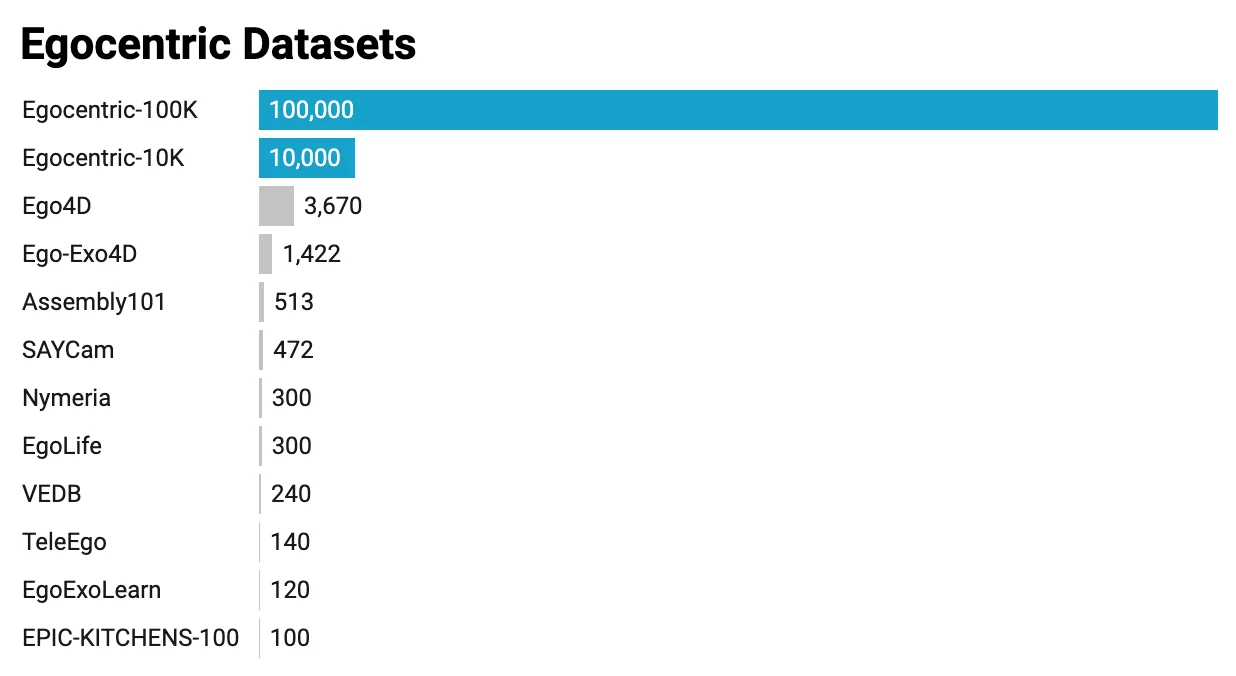 Data scaling in action: Build AI's Egocentric-100K is an order of magnitude larger than predecessor datasets and dwarfs established benchmarks like Ego4D and Assembly101. Source: Humanoids Daily
This is why the data collection boom in India matters so much. The bottleneck for general-purpose robotics is no longer just better robot hardware. It's the sheer volume of high-quality human demonstration data. And India, with its massive manufacturing workforce and low costs, has become the world's primary source.
Build AI's Eddy Xu has hinted at the next evolution: wrist-mounted cameras that capture close-up, high-fidelity manipulation data. "Wrist cam changes everything," he posted, suggesting that the industry is moving beyond head-mounted POV to even more granular capture of finger-level detail.
 Raw footage is transformed into structured training data through annotation, 3D scene reconstruction, and segmentation — the pipeline that turns human motion into robot intelligence. Source: Quasa.io
The Ethics and the Economics
The egocentric data boom raises questions that India's regulatory framework is not yet equipped to answer.
The Digital Personal Data Protection Act, 2023 provides some guardrails, but enforcement in factory supply chains remains weak. Workers contributing to the creation of valuable behavioral datasets often do not share in the long-term economic benefits. Data ownership is murky. And the power imbalance between global AI companies and Indian factory workers is extreme.
From an economic perspective, however, the momentum is unstoppable. The AI training data market is projected to hit $8 billion by 2030. India offers a 5x cost advantage over US-based collection.
Capgemini's April 2026 research found that 67% of executives view physical AI as "game-changing," and two-thirds of organizations rank it as a high priority for the next 3–5 years. Yet only 4% currently operate physical AI at scale. The other 96% are in pilot phases — and they all need data.
 Who owns the data? Who benefits? The ethical fault lines running through India's egocentric data industry remain largely unresolved. Source: Quasa.io
What's Next
The egocentric data industry in India is evolving rapidly. Early players relied on off-the-shelf GoPros and Meta glasses. The next generation is building proprietary hardware: multi-camera depth rigs, wrist-mounted sensors, haptic gloves that capture force feedback.
The annotation layer is deepening too. Raw video is no longer enough. Companies now offer frame-by-frame action labeling, 3D scene reconstruction, segmentation masks, and torque analysis — turning footage into structured training data that models can directly consume.
And the applications are expanding beyond factories. Humyn AI collects residential task data (washing dishes, folding laundry) in Brazil. Figure AI partners with Brookfield to film movements in 100,000 real homes. The goal is robots that don't just assemble electronics but navigate cluttered kitchens, make beds, and care for the elderly.
 The pipeline: motion data captured in Indian factories flows to robotics labs in Silicon Valley, powering the next generation of humanoid robots. Source: Quasa.io
The question is whether the humans recording this data will share in the value they create — or remain, as one critic put it, "the hidden hands behind the handless machines."
Sources and References
-
The Economic Times — "Egocentric data collection fuels AI robotics growth in India" (May 2026) — Profiles Humyn AI, Objectways, FPV Labs, Neo Cambrian, and the scale of demand from robotics labs.
-
Times Now — "Big Tech May Be Using Indian Factory Workers To Train AI" (May 20, 2026) — Reporting on Pearl Global Industries, Egolab.AI, worker conditions, and surveillance concerns.
-
India Times — "Why are Indian factory workers wearing head-mounted cameras?" (May 2026) — Overview of data capture labs, viral footage, and labour concerns.
-
Stellaris Venture Partners — "Physical AI Has a Massive Data Problem" (2026) — Venture thesis on the egocentric data bottleneck, the data pyramid, and market sizing ($1.5B–$50B cumulative spend).
-
Humanoids Daily — "Build AI Scales to 100,000 Hours as Data Scaling Becomes Robotics' New Frontier" (May 2026) — Technical details on Build AI's Egocentric-100K dataset, funding, and the scaling thesis.
-
ManuData — Company website and methodology. Multi-camera depth capture, 3D body/hand pose extraction, 6DoF object tracking across Indian MSMEs.
-
Quasa.io — "The Hidden 'Hand Farms' of India: Fueling the AI Robot Revolution with Human Motion" (May 2026) — Overview of data capture labs, worker conditions, and the economics of annotation labor.
-
Capgemini Research Institute — "Physical AI: Taking human-robot collaboration to the next level" (April 2026) — Executive survey: 67% view physical AI as game-changing, 4% operate at scale.
-
NDTV Profit — "Big Tech Using Data From Indian Factory Workers' Wearable Cameras To Train Robots" (May 2026) — Reporting on viral factory videos and the Egolab.AI connection.
-
News18 — "Cameras On Their Heads While They Work?" (April 2026) — Coverage of the viral Pearl Global footage and public reaction.
-
SHIRO BPO — Mysore-based data annotation services for humanoid robotics, including 3D point cloud labeling and sensor fusion.
-
Sentientx — Robotics training data collection including teleoperation, motion capture, and real-world RL data with India operations.
ragTech is a podcast by Natasha Ann Lum, Saloni Kaur, and Victoria Lo where real people talk about real life in tech. Our mission is to simplify technology and make it accessible to everyone. We believe that tech shouldn't be intimidating, it should be fun, engaging, and easy to understand!
✨ragTech Spotify: https://open.spotify.com/show/1KfM9JTWsDQ5QoMYEh489d
✨ragTech YouTube: https://www.youtube.com/@ragTechDev
✨Instagram: https://instagram.com/ragtechdev
✨Other Links: https://linktr.ee/ragtechdev
Recommended Articles



Subscribe to our newsletter!
Read articles from ragTech directly inside your inbox. Subscribe to the newsletter, and don't miss out.